
For a book I’m writing, I’ve spent an awful lot of time in the year 1883. It was a good year, more or less, and I’m come to understand the manner of speech, the outlook of the people, and, in short, to breathe their air. As a historian once said, keep researching until you can hear the people talking to you. I think this was meant metaphorically. You aren’t supposed to read so much that you develop schizophrenia. I think.
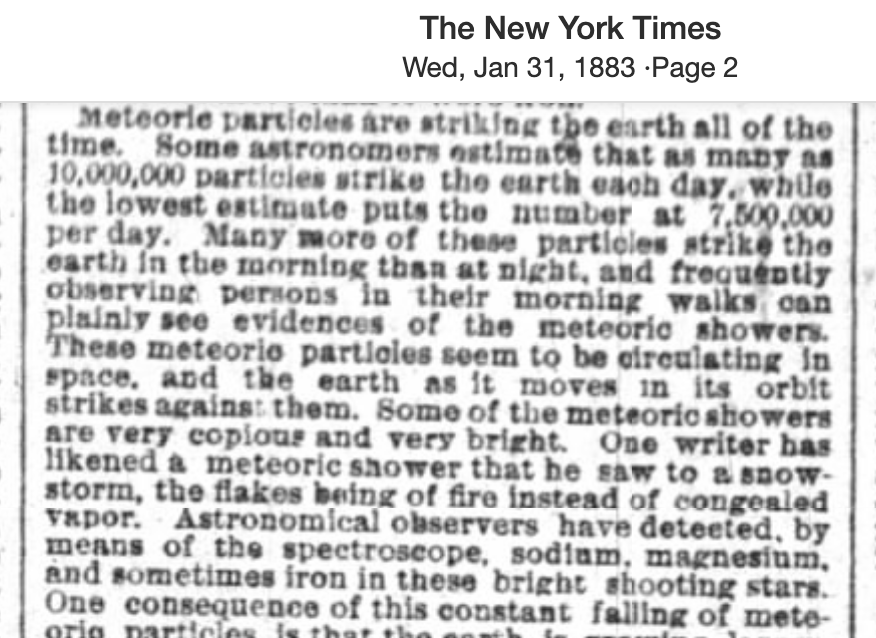
At any rate, I wanted to point out this comment in an article in the New York Times from 1883. The writer says that meteorites are more likely to strike the Earth in the morning than at night. Now, I assume that meteorites come down at relatively the same rate, regardless of the time of day, but that they do increase and decrease in number over the course of the year as the Earth moves around the Sun and into areas of space with more debris. Unless the writer is assuming that the morning lasts for more hours than does the night, I cannot see how someone could reason that more meteorites fall in the morning than at night.
What do you think the argument or justification for this view would be?




 Michael J Douma
Well, night starts at 12 a.m., and ends at 6 a.m., so that’s 6 hours. Morning starts at 6 a.m. and ends at 12 p.m. – also 6 hours. But some people may start night earlier, e.g. at 10 p.m., and make it longer. Whether or not night is longer or as long – in my experience it is dark at night, and I don’t see the many meteorites that fall. And because most of them are small, I don’t find them in the daytime, and when I find one in the daytime, it is only rarely that I can swear on the fact that it was absent during yesterday’s daytime, so it must have fallen during the night.
Another observation, not based on personal experience (although I am old enough to have much personal experience): prior to 1883, most meteorites fell in the morning, but effective (about) that year, the pattern changed, and they started predominating in the night – likely because expanding street lighting made it more possible to have their descend observed.
Mother nature is always full of surprises!
MPJM Dijkers
LikeLike