I predict that in the future, Google (or whatever its parent company is called in the year 2525) will sell the entire Gmail database as a source to be mined for historical data. This will of course raise a host of issues concerning privacy, but as long as the search is restricted to a point deep enough in the past, we will probably accept it as too useful a research tool to neglect.
At some point along our path towards the singularity, historians will be using such incredibly large datasets that one might wonder if perfect history is possible. Can ALL historical data be brought together to tell ONE definitive version of history? ONE story?
I don’t think so. Even if we become as powerful as the pscyhohistorians of Isaac Asimov’s Foundation Series, nearly omnipotent like Astinus of Palanthas, or as everlasting as Uata, the Watcher of the Marvel Universe, complete history remains out of our grasp.
History can never be just one story because history is told through the subjective lens of the author. Each perspective on the past offers a different way of looking at things and the facts of the past can always be arranged in new ways.
A similar issue, though, is whether we can theoretically write all history, that is, Can historians ever finish writing? Do we come to an end in our research? Is history finite? Or are there an infinite number of stories we can tell?
Now, if you ask the Internet if History is finite, you will receive various answers about whether time is infinitely deep, or if the universe was born or has already existed, whether it will come to an end or continue forever. This is not what I talking about here. My concern is whether history writing itself is, theoretically, philosophy infinite or finite?
There is a parallel from the game of chess. There are, apparently (and I didn’t do the math) roughly 10^44 to 10^50 possible legal unique chess positions. The actual number of possible chess games is considerably larger at perhaps 10^120. So, in theory, chess is finite.
Is history then like chess? If there are a finite number of atoms in the universe, and a finite number of possible combinations or ordering of such atoms, then it seems that the possible historical configurations is indeed finite.
However, since history is told from subjective perspectives, and the facts of history can be arranged in various ways, history writing might better be seen as infinite. In this, a better parallel might be music. Are there a finite or infinite number of songs? Suppose we define individual musical notes as existing at certain frequencies and accept that there are a limited number or possible notes. Even then, we can arrange these notes in a seemingly infinite number of ways, with various intervals of time between then. Meanwhile, the number of possible instruments layered on top of each other seems nearly infinite, or perhaps infinite in its own right. So, the total number of possible songs may be infinite.
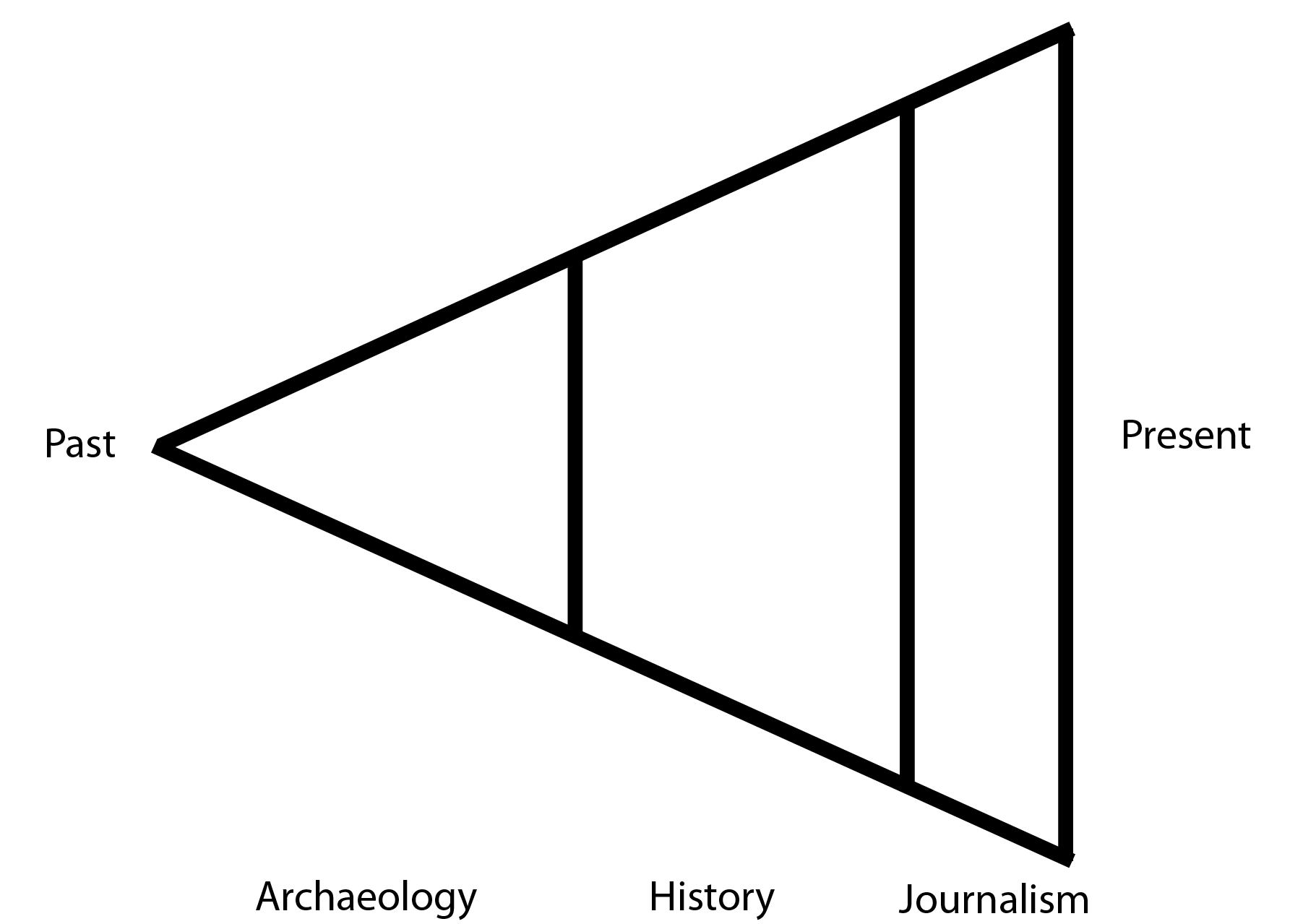
In my book, Creative Historical Thinking (2018), I explain that historians looking at the deep past use fewer sources. For example, an archaeologist might have nothing more than a piece of pottery available. Historians of the medieval period often have only a few records available. Historians of the nineteenth century (my era) work in the sweet-spot, the goldilocks zone, where there are just enough sources to tell a story, but not so many that we are overwhelmed and unable to read even a percent of the relevant available material.
With the arrival of AI, our ability to analyze large datasets has increased significantly. I recently had Gemini analyze and produce graphs and charts from a large database I have used in my own research. Gemini did in 15 seconds what took me months to do before. Now, the results of the Gemini analysis were not perfect, but they were good, and I can imagine a not-so-distant future if which AI can analyze the entirety of archive.org historical sources, or the like, and produce synthetic, analytic history that will blow our historical socks of off.