
Harry P. Van Walt (1888-1963) arrived in the United States in late 1940 as a refugee fleeing wartime Europe. In the following decade, he would present himself to thousands of impressionable Americans across university campuses and civic clubs as a world-traveler, Ph.D. psychologist, renowned journalist and author, diplomat, and a high-profile target of the Gestapo who had narrowly escaped Europe with his life.
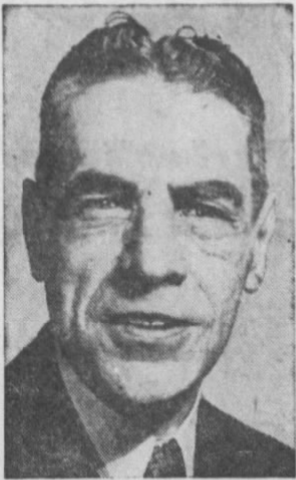
Van Walt was a man who claimed to speak ten languages, to have lived in a dozen countries, to have studied at Leiden, Oxford, and Bonn, and to have held an honorary professorship at the Sorbonne. He spoke with such aristocratic polish, authority, and hypnotic charisma that virtually no one—neither the newspapers that covered his speeches, the civic leaders who hosted him, nor the federal agencies that employed him—ever publicly questioned his credentials.[1]
Modern archival research, however, reveals a far more complex identity. Van Walt was neither a university professor nor a licensed psychiatrist, but a former furniture salesman, importer and leading figure in the European parapsychology and spiritist movement who skillfully adapted his persona to fit the expectations of his adopted home. In short, Van Walt was a confabulist, one who adds to stories, distorts them, and even believes his own fabrications. His story is a study in shifting identities, wartime propaganda, and the limits of historical memory.
The man who would charm wartime America was born on November 25, 1888, in Schoonhoven, the Netherlands. Civil birth records record his birth name as Hendrik Pieter Walt van Praag. In the year 1900, through an official administrative amendment, his name was formally recorded as Hendrik Pieter Walt van Walt van Praag. The distinctive ‘double van’ surname—van Walt van Praag—was the legacy of a mid-nineteenth-century marriage between his great-grandmother, Maria Helena van Walt, and his great-grandfather, Isaac Salomon van Praag.
The “van Praag” name carried distinct historical roots. Etymologically, it denoted origins “from Prague,” signaling a Jewish lineage that had sought refuge in the Dutch Republic centuries earlier. While Van Walt’s immediate household were Remonstrant Christians, the ancestral connection to the Jewish diaspora was an inescapable fact of his genealogy, a detail that would acquire terrifying significance during the rise of National Socialism in Europe. In late 1942, when Harry’s octogenarian mother died in occupied Holland, German authorities explicitly labeled the deceased “arischen” (Aryan) and Harry’s father “Jude” (a Jew).[2]
Despite his later claims of aristocratic origin, Van Walt belonged to the comfortable Dutch middle class. His grandfather had been a respected medical doctor who graduated from the University of Leiden in 1891. His father was a marine engineer and shipping expert, and his maternal grandfather was an apothecary. These were honorable, educated professions, but they were not the nobility Van Walt later claimed when describing his childhood home to American reporters.
Municipal archives track young Harry’s movements across Western Europe in the early twentieth century: In 1907, he was living with his parents in Watergraafsmeer, near Amsterdam, working as an office clerk. In 1911, at twenty-three years old, he moved to Germany and worked as a commercial salesman (Kaufmann) for the transatlantic Hamburg-America Shipping Line. On May 16, 1914, he married Elfriede Elisabeth Auguste Boeddinghaus in Düsseldorf. Elfriede belonged to a wealthy German industrialist family involved in the textile manufacturing sector in the Rhineland. That month, the newly married couple moved to Menton, France, a Mediterranean town nestled between Monaco and the Italian border, where Van Walt may have already been working for up to a year. By August, with the outbreak of the First World War, the couple relocated to the neutral Netherlands.
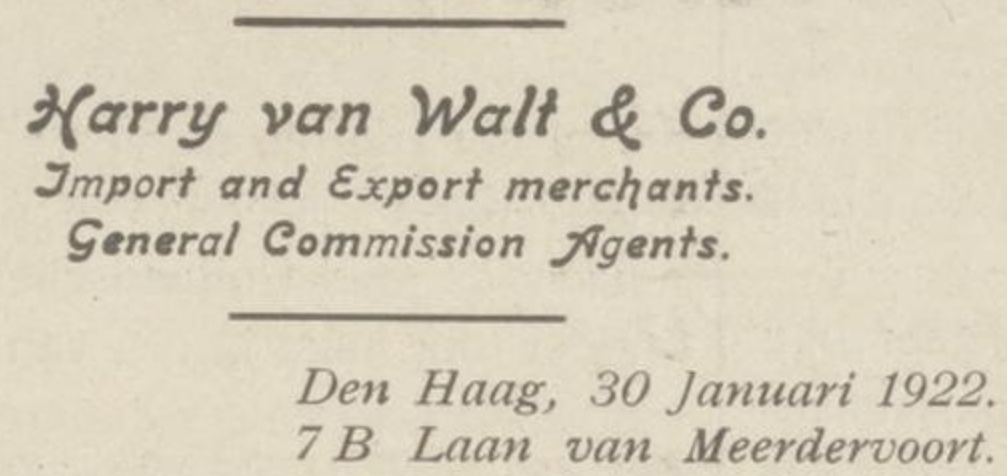
Throughout the late 1910s and 1920s, official Dutch documents identify Van Walt not as a scholar, but as a merchant. In 1915 and 1920, he is registered as a furniture salesman. By 1921, he had established an independent commercial import firm in the Hague. It was during this period that he began systematically simplifying his name for business correspondence, dropping “van Praag” to sign himself as “Harry Van Walt”. [3]
If commercial trade provided his income, it was the world of occult philosophy and parapsychology that captured Van Walt’s true passion. During the interwar years, Western Europe experienced a massive resurgence of interest in spiritism, a movement that sought to apply scientific methodology to the study of the afterlife, mediumship, and physical manifestations of the soul.
Unlike Anglo-American spiritualism, which often revolved around religious sentiment, continental spiritism, heavily influenced by the writings of Allan Kardec, framed itself as an empirical science. Van Walt threw himself into this movement with energy. Writing under the name “H.P. Van Walt,” he became an editor and frequent contributor to Dutch parapsychology periodicals and served as a translator of French and German spiritist texts.
The Evolution of His Name:
– Hendrick Pieter van Walt van Praag (1888-1920): Office Clerk/ Shipping Agent
– H.P. Van Walt (1920-1939): Importer/ Salesman/ Spiritist Researcher and Translator
– Dr. Harry P. Van Walt (1940-1951): Anti-Nazi Refugee/ Lecturer
– “Dr. Van Walt” (1952-1963): Maryland Capital Gazette Pop-Psychology Columnist
Van Walt was far more than an observer. He served as an executive officer for “Harmonia,” a major spiritist association in the Hague, and was even appointed executive secretary for the International Spiritist Federation. In September 1930, he traveled to Barcelona as an official Dutch delegate to the World Spiritist Congress.
The Van Walt home in the Hague became a recognized salon for mediumistic research. Séances were regularly held in their parlor, attended by local intellectuals, psychical researchers, and curious onlookers. These circles were not merely abstract academic exercises for the family; they were deeply personal. In 1920, Harry and wife Elfriede had suffered the devastating loss of their five-year-old daughter. In subsequent years, the couple claimed to receive direct communications from her spirit during quiet home sittings. At one notable Hague séance in the early 1930s, attendees recorded hearing the materialized voice of Sir Arthur Conan Doyle, the creator of Sherlock Holmes and a fervent spiritualist who had died in 1930. Van Walt proudly informed his guests that he had known Doyle personally.
It was through Spiritism that Van Walt cultivated his public speaking abilities. He lectured across the Netherlands on various topics in parapsychology, from life after death, to capturing spirits on photograph. To enhance his credibility, he adopted the authoritative vocabulary of European psychology, framing occult phenomena in terms of “psychic dissociation” and “telepathic suggestion.” When he lectured in Iowa a decade later, the local Dutch-language newspaper De Volksvriend reported that he was a famous European professor of zielkunde, an archaic Dutch term for psychology or “soul-science.”[4]
In 1936, the trail of H.P. Van Walt in the Netherlands suddenly goes cold. Municipal records note that he moved abroad, but his precise destination was unrecorded. He ceased publishing in Dutch Spiritist journals, resigned his positions in “Harmonia,” and disappeared completely from public records for nearly five years. Where did Van Walt go? In later years, he would offer wildly contradictory explanations. He claimed he was living in Palestine, Russia, or Japan, or he was visiting European universities, lecturing about psychology and warning against rise of Naziism. He often claimed he had been living in Brussels, managing a second family residence. In 1938, in the middle of this period of relative anonymity and silence, he suddenly appeared on Belgian national radio for fifteen minutes to speak about parapsychology.[5]
On May 10, 1940, Nazi Germany launched its Blitzkrieg against the neutral Netherlands, Belgium, and Luxembourg. Luftwaffe bombers swarmed the skies over the Hague, paratroopers dropped onto surrounding airfields, and the Dutch military struggled to defend the nation. Five days later, the Dutch armed forces surrendered, and Queen Wilhelmina fled to London to establish a government-in-exile.
Out of this trauma, Van Walt constructed a cinematic story of escape that would form the dramatic centerpiece of his American lecture circuit. As he related it to spellbound audiences in Rotary Clubs and university auditoriums from Maine to California, his flight happened like this:
Awakened at dawn on May 10 by the roar of German bombers overhead, Van Walt looked out his window to see ‘flames reaching to the sky’ near the Hague. The Dutch army requisitioned his private automobile for war service, placing a large sticker on the windshield. But he “re-confiscated” the car, and hit the road, with the sticker unremoved. Each time he was questioned, he pointed to the sticker, and said he was delivering the car to the next army depot.
With dikes collapsing and floodwaters filling the fields, he made his way to the Belgium border. When a crucial bridge over a river was intentionally destroyed to hinder the oncoming German forces, a farmer sold him two flat-bottom barges. Van Walt lashed the barges together, drove his car aboard, and single-handedly paddled himself, his automobile, and (in some versions) his companions across the rushing waters.
Near the Belgian border, he watched enemy parachutists drop from the clouds, only to see Dutch marksmen shoot them down; mid-air, several panicked Germans released their parachute harnesses to fall to their deaths.
In Belgium, he navigated through active minefields and saw German planes strafe refugee columns on the highway.
Slipping across borders into France, and Spain, he dodged Gestapo agents at every turn. Months later and nearly out of cash, the American consul in neutral Lisbon secured him passage on an ocean liner.
It was a breathtaking narrative—part war thriller, part moral crusade. It presented Van Walt as a heroic figure who had lost everything in defense of liberty.
When we cross-examine Van Walt’s escape tale against the archival record, the story fractures into fascinating contradictions.
On October 4, 1940, the Greek passenger steamer SS Nea Hellas departed from Lisbon. It arrived in New York on the 13th. Operating under neutral flags, the Nea Hellas was one of the few remaining evacuation ships carrying refugees out of war-torn Europe. On its passenger manifest, we find the entry for Hendrik van Walt van Praag, age 52. However, his legal wife, Elfriede, was not on board. She remained behind in occupied Holland; the couple would be formally divorced by Dutch courts in 1947.
Instead, Van Walt was traveling in the close company of a 50-year-old Dutch woman named Catherina van den Bok and her four adult children: Jacoba (25), Catherine (23), Robert (19), and Anthony Thomas (17). Catherina was the ex-wife of Robert Abraham Anthony Fruin, a wealthy planter and former leading member of the Volksraad (the governing body of the Dutch East Indies). The four Fruin children had all been born in Medan, Sumatra but largely schooled in Europe. All six members of this group had been issued entry visas simultaneously at the American Embassy in Madrid on August 5, 1940.[6] The National Archive of Portugal records these six “holandês” registering for visas together in Lisbon on September 27.
In short, the “wife and four young children” Van Walt sometimes claimed to have rescued across war zones were actually his traveling companions, his mistress Catherina and her children.[7] The second family residence Van Walt sometimes claimed to have been maintaining in Brussels was in fact a residence with a second family. Harry and Catherina had been well acquainted by 1938, when the latter was fleeing a tumultuous marriage and legal proceedings with her second husband, Theodorus (Theo) Steenkamp.[8]
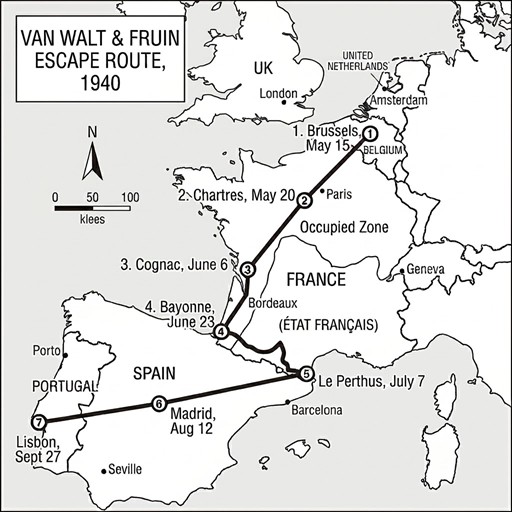
By 1942, the Fruins were publicly relating their escape story to American audiences. In one version, the two sons bicycled to Brussels from the Hague, in another version Thomas was studying in Essen and cycled to Antwerp where his uncle with an automobile happened to spot him and bring him to Brussels.[9] At any rate, they all rendezvoused in Brussels. Mother Catherina said that she and “five members” of her family fled from Brussels on May 15th, 1940, five days after the Nazi invasion began. Daughter Catherine added that the family drove by car to France, then took a train to Spain. To explain her father’s absence, Catherine said he stayed behind in Holland to take care of his mother.[10]
In the U.S., after Harry and Catherina had gone separate ways, and it no longer suited his narrative, Van Walt simply altered the plot, omitting any reference to this erstwhile family. In 1945, he informed American reporters that his entire family had been “assassinated by the enemy” in Holland.
The voyage of the SS Nea Hellas provided Van Walt other inspiration. Also on board that same October crossing were over fifteen prominent anti-Nazi European intellectuals, journalists, and political dissidents fleeing persecution. Surrounded by genuine literary celebrities and political targets on the high seas, Van Walt realized the cultural currency of the anti-Nazi writer. By the time the Nea Hellas passed the Statue of Liberty, Van Walt had absorbed their collective aura. Gradually, he came to see himself as an exiled European intellectual ready to educate America.
Upon landing in New York City, however, Van Walt found refuge in the subculture he knew best: American spiritualism. In July 1941, he attended the General Assembly of Spiritualists held at the Hotel Astor in New York City. In November of that year, he secured formal employment as a Research Associate at the Institute of Hyperphysical Research, an esoteric research organization based in Manhattan. He began booking speaking engagements at local psychical societies, more than once delivering a lecture titled “My Escape and Hazardous Five-Month Trip to America”. In the summer of 1942, Van Walt participated in a highly publicized séance in New York City, where the famous American medium Frank Decker claimed to channel the spirit of the late Harry Houdini.[11]
While spiritualist lectures provided temporary income, the entry of the United States into World War II following the attack on Pearl Harbor in December 1941 opened a much larger, more lucrative opportunity. The Dutch government-in-exile in London was desperate to maintain American public support for the liberation of the Netherlands and the recovery of the Dutch East Indies from Japanese occupation. To accomplish this, the Dutch ministry established the Netherlands Information Bureau (NIB), operating out of 10 Rockefeller Plaza in New York City. The NIB functioned as an official propaganda wing, placing news stories, producing films, and sending articulate Dutch speakers on nationwide tour circuits.
Sometime in early 1942, NIB officials crossed paths with Van Walt. He was an ideal representative: he was tall, impeccably groomed, with distinguished graying hair and an aristocratic posture. He possessed a commanding, mesmerizing speaking voice and spoke flawless, fluent English with a charming European accent. His fierce anti-German, pro-Democracy rhetoric required no oversight; his personal views aligned perfectly with state objectives.
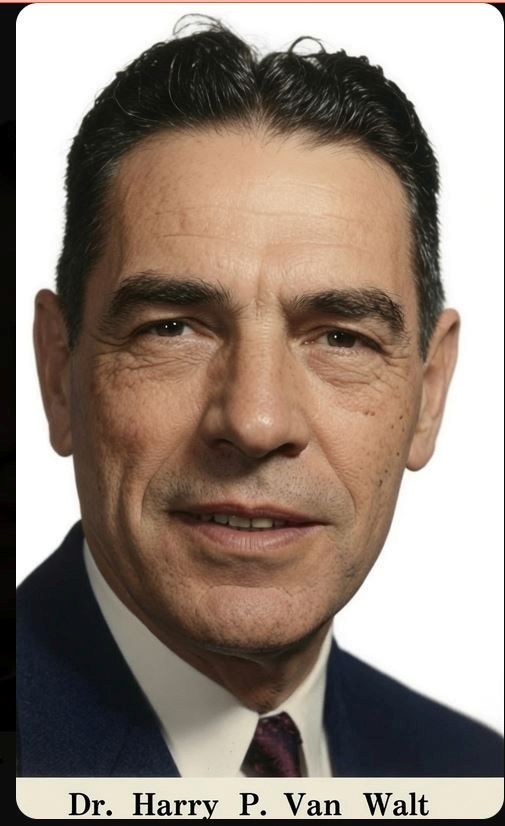
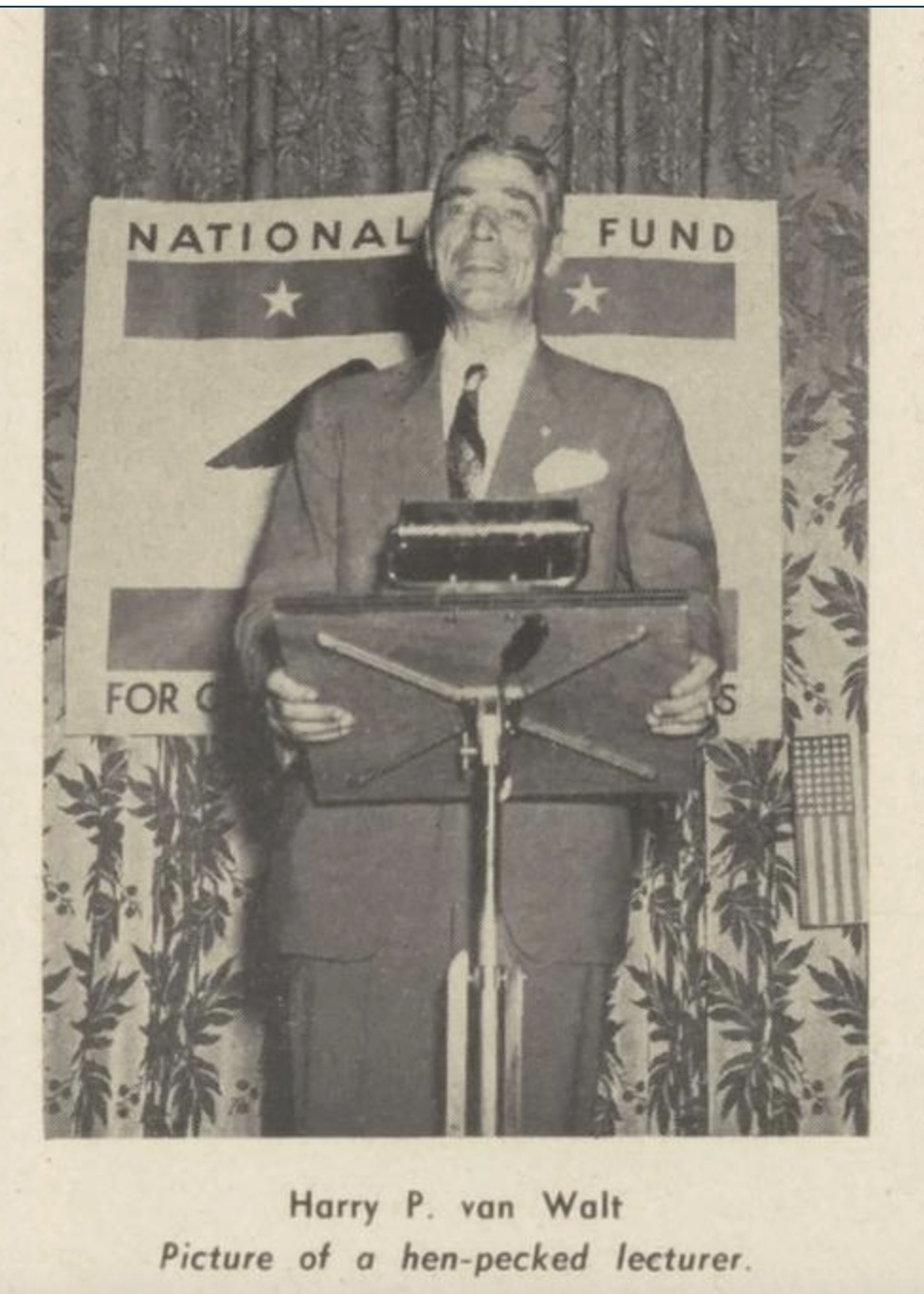
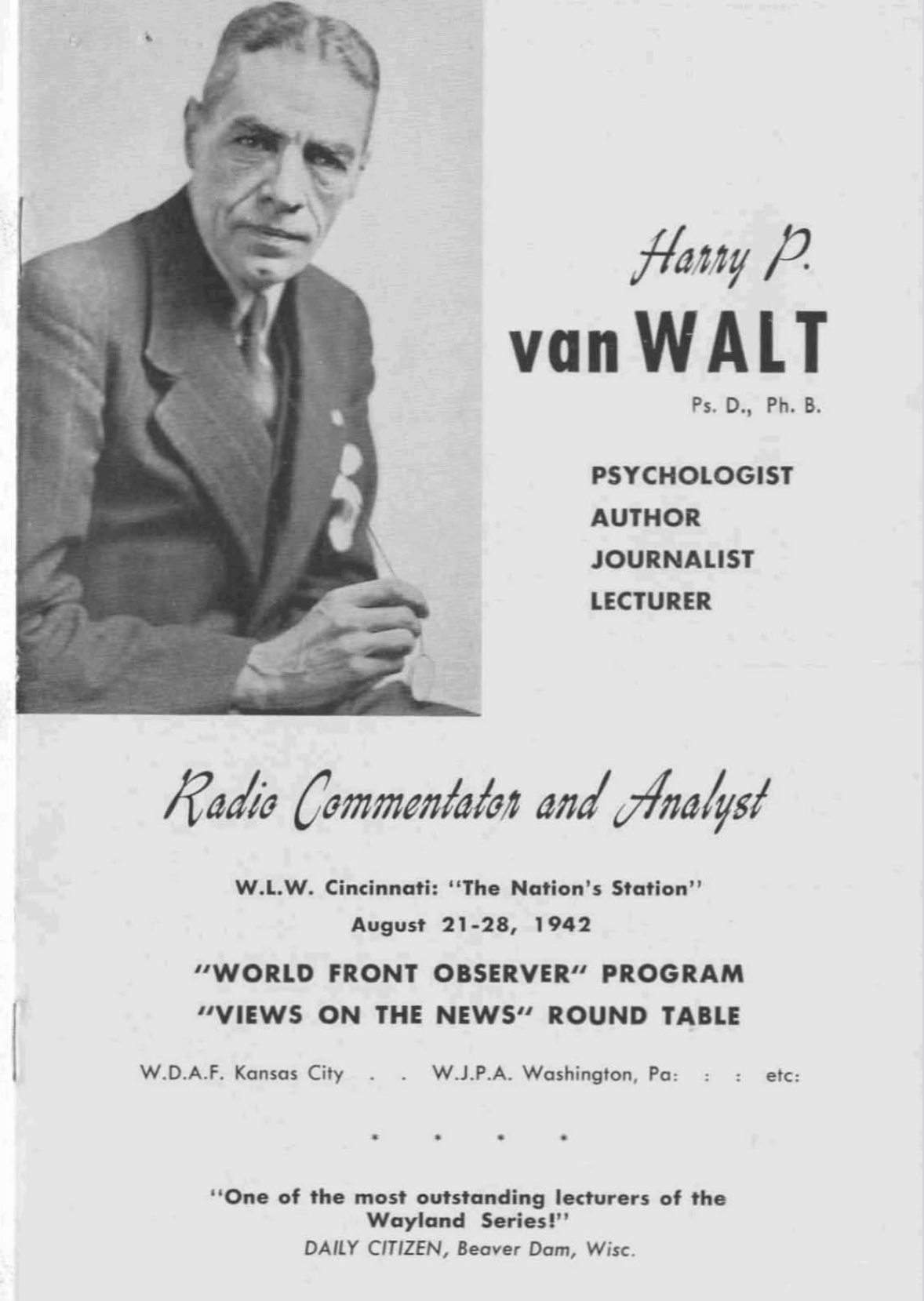
The NIB officially registered Van Walt as a foreign agent under the Foreign Agents Registration Act and began booking him for extensive speaking tours across the country. Between 1942 and 1949, Van Walt delivered an astounding number of lectures, perhaps as many as the 1,800, as he later claimed, across nearly every state in the Union. He spoke to Rotary clubs, Kiwanis chapters, university forums, and women’s civic organizations. “The value of such work…lies in repetition – and continual repetition” he wrote in a 1944 letter to the NIB. This required “many nights on sleepers and in hotels” with “many a denunciation of Nazis” and “many a story of Holland.”[12] To maximize his appeal, Van Walt continually polished his publicity materials. In 1942, he replaced an earlier, stern-looking promotional photograph with a warm, smiling portrait that radiated wisdom and approachable authority.
The professional photograph Van Walt used from 1942 to the end of the decade. (https://www.findagrave.com/memorial/83143277/harry-p-van_walt, accessed 6 August 2026)
Van Walt never stopped in a small town just to speak, but was there en route to somewhere larger and just happened to find the time. As he traveled from town to town, he realized that American local journalists rarely cross-checked biographical details provided in press releases. Consequently, his backstory expanded with each stop. With repeated opportunities to tell his stories and gauge audience reaction, Van Walt could become more confident and adept at deception.
But as Van Walt’s story of close escape evolved, it became more improbable, with more Nazis involved. When the Nazis couldn’t get him in Holland, they “took his daughter into Germany” and her fate remained unknown. Nazi agents had tried to kidnap him in Cincinnati and made numerous threatening telephone calls. Positioning himself an expert on Nazism, Van Walt claimed to have heard and seen Hitler several times before the war. Hitler, said Van Walt, was “hypnotic” and a “remarkable psychologist” because he made people believe things that were not true. Hitler had personally placed a $10,000 reward for Van Walt, who proudly declared that he was “No. 6” on Hitler’s black list.[13] The multilingual scholar also informed his audiences that he “kept in touch with” underground resistance activities not just in the Netherlands, but across Europe.[14]
His speeches were not timid. Van Walt specialized in aggressive attacks on the German national character. He insisted that there was no distinction between “Nazis” and “ordinary Germans,” claiming that the entire population possessed an innate psychological defect that sought authoritarian domination. He warned American audiences against showing mercy to defeated Germany, advocating for harsh, prolonged military occupation and import controls to prevent the Germans from starting a Third World War.
To lend weight to his authority, Van Walt gave himself university degrees from Bonn, Leiden, and Oxford, without ever specifying which degrees were from where, or in what years he received his degrees. His book warning Europe of Naziism, The Coming Menace, which was supposedly published in 1936 or 1937, never existed. The Nazis were not concerned with him. These falsehoods would have been quite difficult for contemporaries to check, but a modern researcher has all the necessary tools to peer into the right archival boxes. It is telling, and no coincidence that Van Walt’s name is missing from all the catalogs, all the registries, and all the lists where he should easily be located as a graduate, a member, a licensed practitioner, or a target of the Gestapo.
When public interest shifted in the late 1940s toward the Cold War, Van Walt seamlessly adapted his lecture topics and added elements to his autobiography. He rebranded himself from an expert on “German Psychology” into an expert on “Soviet Psychology.” He informed Midwestern audiences that he had lived in Russia for two years prior to the war, had toured areas behind the Iron Curtain, and understood the “psychological pathology of the Kremlin”.
During his early lecture tours, Van Walt met Helen M. Fowles, an English-born woman living in New York. Helen was an energetic cultural promoter and event manager. She quickly became Van Walt’s hard-driving, no-nonsense booking manager, business partner, and travel companion. Harry and Helen were married in 1945 in the United States, two years before his formal divorce from Elfriede in the Netherlands. Fowles explained “The doctor and his wife were separated ten years before the war, and he has not heard from her since.”[15] To complicate matters, Catherina van den Bok-Fruin argued that Van Walt owed her several thousands of dollars. According to Fowles, this “hysterical and exceedingly unbalanced woman” made personal and threatening visits to her office in Manhattan. Diplomatic records indicate that Van Walt had helped the wealthy Ms. Fruin transfer money out of Europe in his name. Trying to keep separate her business and personal roles, Fowles added: “It may be of interest (and perhaps, amuse you!) to hear that on her last visit which happened to be timed when I was attending to some business at Dr. Van Walt’s home, she accused me of living with him!”[16]
Harry and Helen lived briefly in Peoria, Illinois, before moving to Maryland, in 1949, intending to settle permanently as professional writers and editors. Between 1945 and 1951, they made at least three extended trips back to war-torn Europe, these experiences later providing support to his claims as a geopolitical analyst and commentator. In one account, Van Walt said he was merely in Nuremburg during the famous war crimes trials. He later claimed to have been an invited as a “special guest” to the trials, where he insisted he had personally exchanged glares with Hermann Göring in the courtroom. In another version, he added that Göring had bowed to him in passing. A special security clearance was required to attend the trials, and today there are quite extensive archival records of the guests and visitors, but Van Walt’s name is nowhere in those records. In returning to Europe to survey the post-war situation, Van Walt explained that he had extra access because he had temporarily been given the rank of “major” in the British Army![17] He claimed he traveled as a guest of the British and American Press Association, but the truth was that his press pass, from the Knickerbocker Weekly, a Dutch-government-funded magazine in New York, provided him little recognition.
By the early 1950s, the national demand for wartime lecture tours had faded. In 1955, Van Walt’s second wife, Helen, passed away, leaving him widowed and living alone in Annapolis. Rather than retreating into quiet anonymity, Van Walt continued to develop his final public identity. From 1952 until his death in 1963, he wrote a daily paid newspaper column for the Maryland Evening Capital under the byline “Dr. Van Walt”. Because he used only “Dr. Van Walt” without his full legal name, this massive body of work—nearly 1,000 short essays preserved on microfilm and digitized databases—could easily be missed by historians.
These columns reveal a remarkable shift in tone. The fiery wartime propagandist and anti-German crusader disappeared completely. In his place emerged a warm, wise, humorous, and deeply compassionate pop-psychologist. He wrote gently about marriage problems, the anxieties of aging, the fear of failure, and the emotional development of children. He frequently cited anonymous patients who supposedly came to his Annapolis office for psychiatric consultations. Whether these patients were real individuals seeking advice from a respected neighborhood figure or imaginary, composite characters created to illustrate psychological points, “Dr. Van Walt” wrote about them with genuine empathy.
His writing contained moments of quiet self-deprecation. In one column, he joked that during his long life he had met at least four women who independently believed they had been Cleopatra of Egypt in a past life. In another piece, he asked readers to imagine the distant year 1995, when the first spaceship launched “of course, from America” reaches Mars, carrying onboard a distinguished guest lecturer—a humorous nod to his own tireless years on the road.
The columns also provided glimpses of historical truth that contradicted his wartime fabrications. In a touching piece about family life, he wrote about playing with toy train sets alongside his ten-year-old grandson in the Netherlands. It was a subtle admission that his Dutch daughter Violet (b. 1919) had not only survived the war, but had married and raised a family of her own, demolishing his wartime claims that his entire lineage had been exterminated by the Nazis.
It is within these daily columns that Van Walt left behind a subconscious blueprint of his own mind. He frequently returned to topics involving adjusting to difficult changes, making a break from the past, and constructing an ideal image of oneself. In a 1953 column titled “How to Analyze People”, Van Walt wrote words that read like an explicit confession to his future biographers:
“To arrive at a more or less correct analysis of a person involves subjecting that person to various tests and it may take considerable time, depending, of course, upon the individual. We have to lift the mask behind the mask behind the mask behind which the real personality is hiding…
A man who is distrustful of others is not usually very reliable himself. He who accuses others of abnormal tendencies may possess the same trends himself, since the projection of one’s own faults and shortcomings upon others is a common device of self-defense… Again psychologically speaking, we admire most in others those traits which we lack ourselves but would like to have.” [18]
In another column exploring narcissism and social isolation, he observed:
“His self-aggrandizement becomes a mental refuge, into which he retires from the attacks and indifference of the world… as in every case of mental disorder, there are various degrees of narcissism, and we encounter it in some form or other more often than we think.” [19]
Perhaps most telling was his essay on storytelling and child psychology, where he recounted telling fairy tales to his young daughter and her friends back in the Hague decades earlier:
“I was a wizard at telling fairy tales, stories about a wolf with a grandmother inside him, about giants and so forth… But I encountered some trouble in presenting fairy tales to a group of children. The children, as children tend to do, were able to spot any inconsistency in the story.
As long as I strictly followed the party line, by which I mean as long as I did not deviate in the slightest in telling my story from that which I had told them the day before… my success was assured and I was the Wizard. But if I had told them on a Monday that the valiant prince who kissed the gal he had to kiss in the story wore silver buckles on his shoes, and I would say on the following Tuesday that those buckles were made of pure gold, a shout of protest would go up: ‘They were silver buckles!’ I was informed in no uncertain terms.
In this, adults are not so psychologically different from children. They both react with what is known as the ‘reiteration compulsion’—a subconscious craving for consistency.” [20]
For Van Walt, consistency was an unwelcome restraint. In his world, the buckles on the prince’s shoes were silver one day, and gold the next. As long as the narrative served a grander emotional truth, such as rallying support against Hitler, comforting a bereaved reader, or elevating his own social standing, the factual details were entirely malleable.
Some of Van Walt’s wildest fabrications were woven into his semi-autobiographical, or rather semi-pseudo-autobiographical book, The Night is Far Gone, published in 1945 with Dorrance Publishers, a vanity press. The book is quite rare and almost impossible to find. The aim of the book was to contrast pre- and post-War Europe, and to establish its author further as a commentator on current international political events. The book chronicles portions of Van Walt’s life, but the stories omit all dates and the chronology is condensed and contorted to mix real and implausible events, much like the stories he told in his lectures. Van Walt’s years living in Germany are treated as a travel account of a tourist passing through. Then, for no apparent reason, he proceeds by cruise to Scotland, Iceland, and the Faroe Islands. He immediately follows that with a trip down the Danube, to Vienna, Budapest, and Belgrade, and finally Constantinople. Here, the descriptions feel forced, as if taken from travel literature. Then, without justification, he heads to Russia, where he ends up dancing with the Princess “Petrovna Federovna” (a composite character of multiple real members of the House of Romanov). The heroic protagonist leaves Russia, travels to Stockholm and Copenhagen, and then on to London, only to circle around to Italy and the French Riviera, where he befriends Prince Albert of Monaco and again sees the same Russian princess. Van Walt indicates that all of this travel took place before 1914. Then, skipping ahead to after the Great War, he is in Paris and is invited by Russian diplomats to a fancy ball, where he encounters the Russian princess for a third time, and spends the evening dancing with her. Even in this fantastical account, Van Walt hasn’t gone around the world twice, as he often claimed, but only around Europe once, in a most unusual direction.
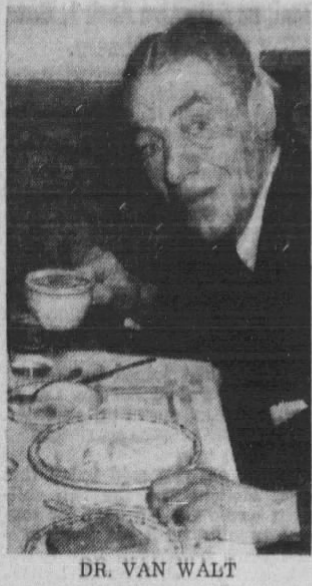
Harry Van Walt died of heart attack in Annapolis, Maryland, on April 10, 1963, at the age of 74, although local newspapers reported his age variously as 73 and 76. On the official record, the names of his parents were recorded as “Unknown”—a final, fitting symbol of a man who had successfully severed his American self from his Dutch past. His obituary presented a polished summary of the persona he had spent years refining. He was remembered as a distinguished European scholar, an aristocratic refugee, a psychiatrist, and a beloved columnist who had dedicated his final years to helping others understand human nature. The local reporters noted that complete details of his early life were “pending information from his daughter in Holland.”[21]
What are historians to make of Harry P. Van Walt? It is easy to dismiss him as a confidence man or a pathologically narcissistic imposter. He lied about his academic degrees, fabricated books, embellished his wartime danger, and abandoned his legal wife in occupied Europe while traveling with another woman. Yet a purely moralistic critique misses the broader historical and psychological reality of the trauma he experienced. Van Walt lived through two world wars, lost a daughter, and faced the terrible threat posed by his family’s Jewish heritage in Nazi-dominated Europe. Constructing a grand, aristocratic and academic persona was a coping mechanism, a psychological fortress built to protect a fragile ego against the horror and chaos of twentieth-century history.
The modern experience of transatlantic migration has always allowed individuals to sever ties with past failures. Crossing the Atlantic provided a blank canvas upon which a charismatic individual could write a new autobiography. Van Walt took advantage of a historical moment when American curiosity about Europe was vast, but American capacity to verify European credentials was virtually non-existent.
Van Walt’s fabrications served a real war effort. As an official agent for the Netherlands Information Bureau and the National War Fund, his speeches likely raised thousands of dollars for war relief, energized American support for Allied military campaigns, and kept the plight of occupied Holland in the public consciousness. In his mind, inventing a backstory was a morally justified instrument of psychological warfare against National Socialism.
In the end, we must recognize Harry Van Walt as a master storyteller. Whether translating spiritist treatises in the Hague, delivering anti-Nazi speeches at American colleges, or writing daily psychology columns in Annapolis, he understood that human beings do not crave objective facts, they crave meaning, comfort, and narrative structure. In telling his story, he wrote one of the most fascinating, enigmatic chapters in the history of the Dutch-American diaspora.
[1] Hundreds of small-town newspapers reported on his lectures. “Pottstown Mercury (Pottstown, PA), 10 February 1950; The Plain Speaker (Hazleton, PA), 23 Oct, 1943; Bureau County Democrat (Spring Valley, Illinois), 22 March 1946.
[2] Netherlands National Archives, Collection 2.06.68, inventory number 2087.
[3] Het Vaderland: staat-en-letterkundig Nieuwsblad, 8 Jan 1921. The Dutch reads “zich noemende en schrijvende Harry Van Walt.”
[4] De Volksvriend, 13 January 1944.
[5] Volk en Staat, 8 July 1938.
[6] US National Archives, Passenger and Crew Lists of Vessels Arriving at New York, 1897-1957; T715; RG: 85
[7] The Bristol Courier (Bristol, PA), 7 Feb. 1942; Democrat and Chronicle (Rochester, NY), 25 January 1941.
[8] Netherlands National Archives, 2.21.222, number 126.
[9] Rollins Sandspur, 4 February, 1942; 22 November 1944.
[10] Orlando Sentinel, 28 February, 1943; Oskaloosa Independent, 9 March 1944.
[11] New York Spiritualist Leader, 16 November, 1941; Beatrice Houdini, “Houdini Unmasked: Code Message Received” (Lily Dale, NY: Dale News, Inc, 1947), 44.; Psychic Observer, (Lily Dale, NY), 25 June 1941.
[12] H.P. Van Walt to N.A.C. Slotemaker de Bruine. 23 September, 1944. NA 2.05.08, Inventory number 5666.
[13] Rock Valley Bee (Sioux County, IA), 21 Jan 1944; Daily Star-Journal (Warrensburg, MO), 6 January 1943; The Escanaba Daily Press, 17 Nov. 1942; The Sioux County Capital (Orange City, IA), 20 January 1944; Creston News Advertiser (Creston, IA), 28 January 1946; Bureau County Democrat (Spring Valley, IL), 22 March 194; The Record-Argus (Greenville, PA), 4 February 1943.
[14] The Billings Gazette, 27 June 1944.
[15] Helen Fowles to W.R. van Houten, 18 Dec. 1943. NA 2.05.117_25008.
[16] Fowles to Huizinga, 7 June 1943. NA 2.05.117_25008.
[17] Kokomo Tribune, 18 January 1949.
[18] The Berkshire Eagle, 20 June 1953.
[19] Evening Capital, 13 June 1957.
[20] Evening Capital, 26 Jan 1956.
[21] Baltimore Sun, 27 August 1963



Een interessant verhaal over deze man
LikeLike
Dankjewel, Doede.
LikeLike